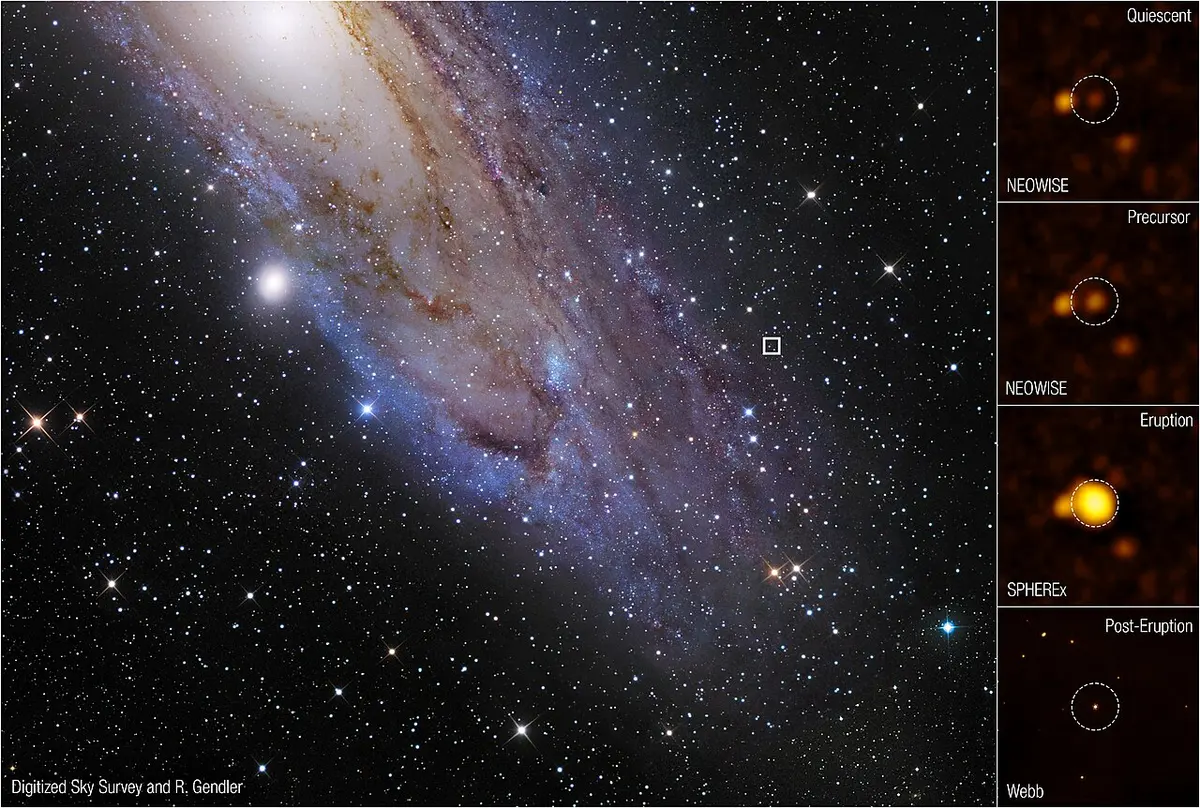
A star in the Andromeda Galaxy brightened for years, then erupted in 2025. The James Webb Space Telescope caught the system 47 days after the peak, when dust around it could help explain the blast.
The system, named AT 2025abao, had a giant star about seven times the Sun's mass and a much smaller companion. The giant was about 350 times wider than the Sun, and its light drowned out the companion. A long-running record of observations let researchers trace the change back years before the eruption.
Astronomers call this process common envelope evolution: one star expands around its companion, and the smaller star spirals through the shared gas. Drag slows its orbit and releases energy. You can picture that energy as the engine behind the giant's slow brightening.
From 2018 to early 2025, the system grew two to three times brighter in visible light. Then, in October 2025, it brightened about 100-fold in 25 days. The eruption shone as brightly as 1.5 million Suns at its peak, and Webb's infrared view helped researchers study dust expelled by the star.
The smaller star was estimated to have about 70 percent of the Sun's mass. NASA's Webb Mission Team account describes Webb's evidence as confirming a merger. But lead author Viraj Karambelkar says dust still hides whether the companion merged with the giant's core or survived. The Webb observations came alongside years of measurements from other telescopes.
This event gives you a rare view of a process usually pieced together after the fact. The useful question now is what will emerge as the dust clears: one merged star, or two stars in a tighter pair. That answer could help explain how some close pairs of stars form.