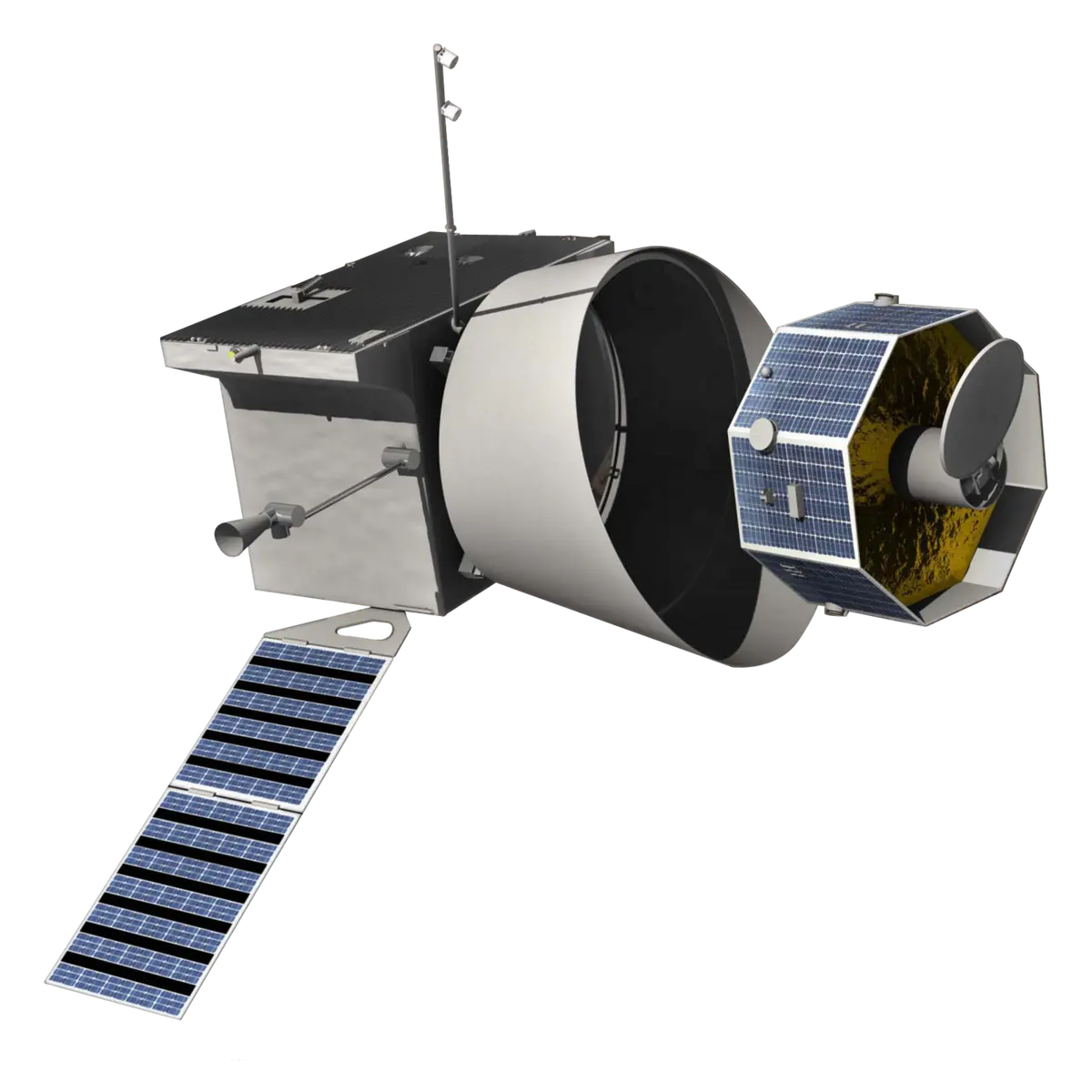
After more than eight years and a journey of 10 billion km (almost 6 billion miles), BepiColombo has arrived at Mercury. The joint European and Japanese mission still has to enter orbit, a step planned for 21 November.
Getting there took careful braking. Mercury sits close to the Sun, whose gravity speeds up a spacecraft heading inward. BepiColombo took a winding route and made repeated passes by Earth, Venus and Mercury to slow down. A propulsion problem also added a year to the planned trip.
In early December, the craft is due to separate into two orbiters. The European probe will map the surface and study the planet's interior. Its Japanese partner will measure Mercury's magnetic field and the very thin layer of gas and atoms around it.
Mercury is 50% larger than the Moon, yet it has four times the Moon's mass. That makes its unusually large metal core a puzzle: the mission will help researchers study how the planet formed and why it is so dense.
The probes will also look for clues to ice in craters that stay in shadow, and investigate shallow hollows scattered across the surface. Science work is due to begin in April 2027, giving you a closer look at a planet that has been explored by only two earlier spacecraft.
The hard part is still ahead: entering orbit on 21 November and splitting the craft in two in early December are the steps that decide whether the science can begin. Until both succeed, arriving is only half the journey.