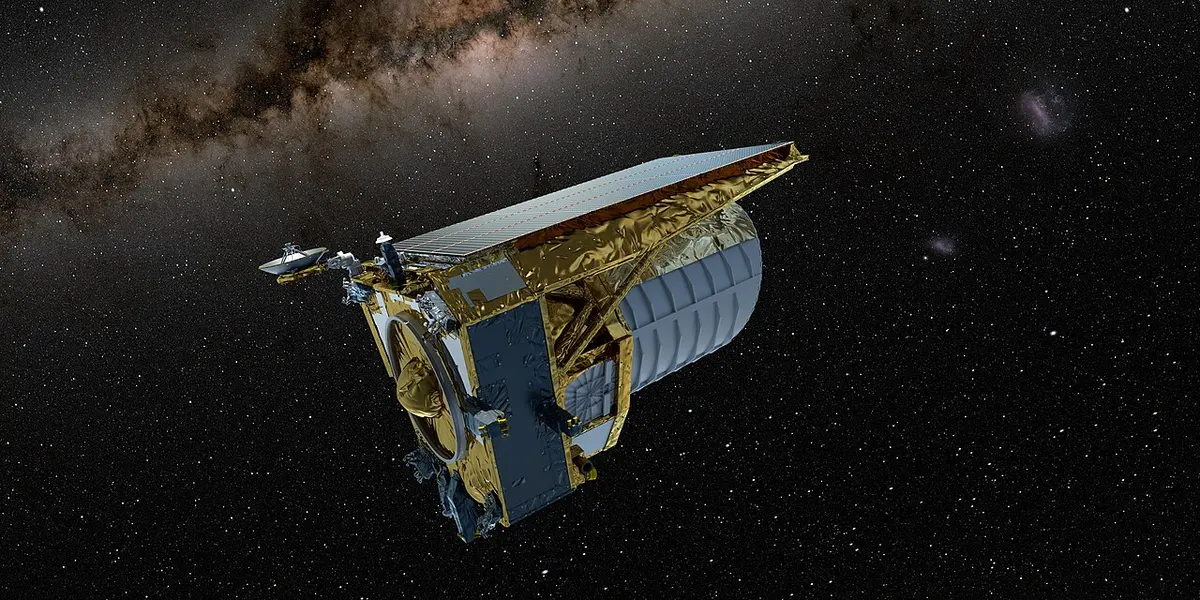
More than a billion objects have come into view in the first major data release from Euclid, the European Space Agency's space telescope. Released on 12 November 2026, the collection brings together about 13 months of observations.
If you look up, this release covers 1,900 square degrees of sky, about as large as 9,500 full Moons. The release includes over 900 million galaxies and more than 160 million spectra. A spectrum is light split into colors, which can help scientists measure how far away a galaxy is.
That matters because a wide view lets scientists study many objects together. Euclid's images include about 15,000 candidates for strong gravitational lensing, when the gravity of a foreground galaxy bends light from a more distant one. Those bent images can help researchers study the mass of galaxies, including their dark matter.
The dataset also includes over 60 million quasar candidates. Quasars are intensely bright centers of distant galaxies, powered by material falling toward a black hole. Together, these objects and the spectra give researchers material to investigate how galaxies are arranged across space and time.
This release is still an early slice of the mission's work: it covers about 14% of the sky Euclid is set to survey. The full first data release is planned for mid-2027, with more observations and measurements of how galaxies fit into the universe's large-scale structure.
The striking part is the scale: rare cosmic sights can now be studied as a group, rather than one at a time. The next thing to watch is what scientists learn from connecting these distant galaxies into a map of the universe.