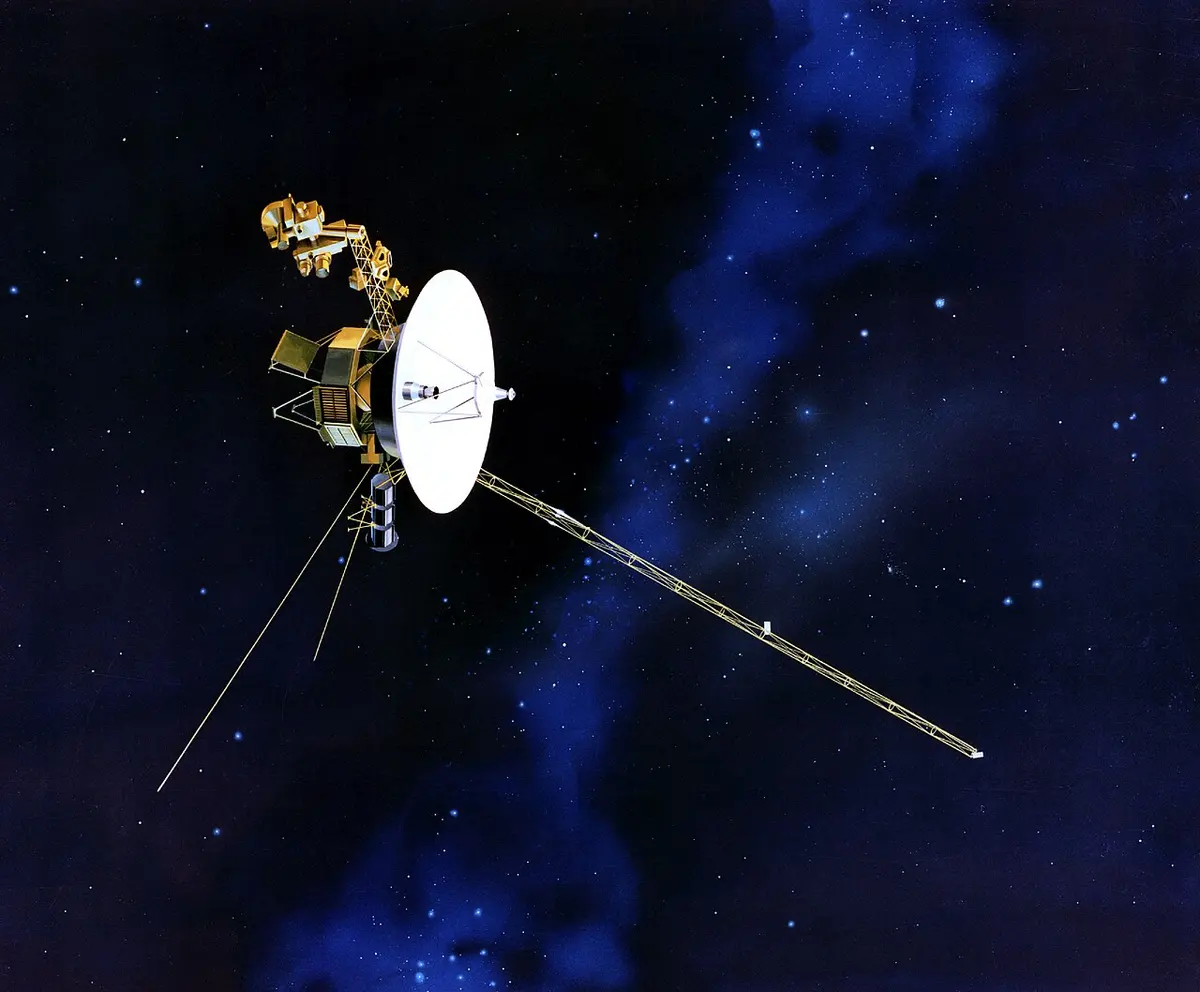
If you sent a radio message to Voyager 1, it would need 24 hours to arrive, and the reply would take another day. The spacecraft crossed that distance on 18 November, after more than 49 years of travel.
A light-day means about 25.9 billion kilometres, the span a beam of light covers over 24 hours. That makes it a useful yardstick for a trip so vast that ordinary road or flight distances stop helping. Voyager 1 is travelling about 61,155 kilometres per hour, yet it took nearly five decades to reach this mark.
The probe launched in 1977 with its twin, Voyager 2, to study the outer planets. In 2012, Voyager 1 crossed out of the Sun's heliosphere, a region shaped by particles and magnetic fields from the Sun, and entered interstellar space.
Its work continues beyond the planets. Both Voyagers measure changes in the Sun's magnetic field far from Earth, helping scientists study how the Sun affects the space around it.
There is a problem right now: since 14 November, the team has not received science or engineering data from Voyager 1. It still sends a carrier signal, a basic radio tone that normally carries that data, and engineers used it with path calculations to confirm the milestone. NASA is looking into the data problem. Time is also short: the probe's plutonium power source is expected to fade out in 2029, ending contact with Earth.
The one-day delay is a striking way to picture how far a machine launched in 1977 has gone. The bigger story is how much science the team can still get from it before its power runs out, which makes fixing the current data problem urgent.